
GLD ISO 639-3
Nanai
Нанай (Nanaj) Autonym
A language of Russian Federation
- ISO 639
- gld
- Alternate Names
- Gold, Goldi, Heche, Hezhe, Hezhen, Nanaj
- Autonym
- Нанай (Nanaj)
- Population
- 1,350 in Russian Federation (2010 census). Ethnic population: 12,000 (2010 census). Total users in all countries: 1,390.
- Location:
- Khabarovskiy Kray: extreme far east, confluence of Amur and Ussuri rivers, scattered in Ussuri valley, Sikhote-Alin, centered in Amur valley below.
- Language Status
- 8a (Moribund).
- Classification
- Tungusic, Southern, Southeast, Nanaj
- Dialects
- Sunggari, Torgon, Kuro-Urmi, Ussuri, Akani, Birar, Kila, Samagir. Quite distinct dialects.
- Language Use
- Severely endangered. Older adults only. Mixed attitudes, from negative to mildly positive. Motivated to use Russian [rus]. Those under 40 consider Nanai unhelpful in life. Older generation pessimistic about possibility of preservation. Shifted to Russian [rus]. Some also use Mandarin Chinese [cmn], especially elderly.
- Language Development
- Literature. Dictionary. Grammar. Texts. Bible portions: 1884–2002.
- Language Resources
- OLAC resources in and about Nanai
- Writing
- Cyrillic script [Cyrl].
- Other Comments
- Traditional religion.
Also Spoken in
- Location
- Northeast corner of Heilongjiang Province, near merge of Heilong, Songhua, and Wusuli rivers, Tongjiang county, Bacha and Jiejinkou villages; Raohe county, Sipai village.
- Dialects
- Qileng (Kilen, Kili, Kirin, Qile’en), Sungari.
- Language Status
- 8b (Nearly extinct)
- Other Comments
- Non-indigenous. Formerly called Sushen. Traditional religion, Buddhist. View other languages of China
Language Name
Nanai
User Population
40 in China (Salminen 2007). About half speak Sungari dialect, half speak Nanai proper (Salminen 2007). Ethnic population: 5,350 (2010 census).
Map
Location: Khabarovskiy Kray: extreme far east, confluence of Amur and Ussuri rivers, scattered in Ussuri valley, Sikhote-Alin, centered in Amur valley below.
Size and Vitality
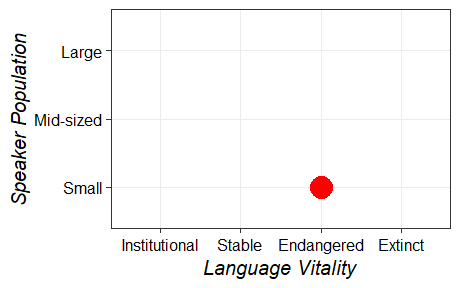 Click to enlarge with explanation
Place in Language Cloud
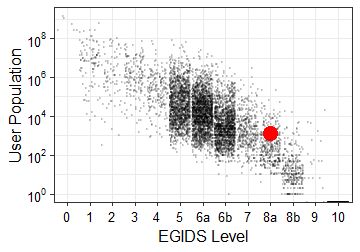 Click to enlarge with explanation