
FRR ISO 639-3
Frisian, Northern
Friisk Autonym
A language of Germany
- ISO 639
- frr
- Alternate Names
- Frasch, Freesch, Freesk, Fräisch, Nordfriesisch
- Autonym
- Friisk
- Population
- 8,000 (Salminen 2007). Ethnic population: 50,000 (2017).
- Location:
- Schleswig-Holstein state: west coast from the German-Danish border region in the north to the town of Bredstedt (district of North Friesland); adjacent islands Amrum, Föhr, the ten islands of Halligen group, Helgoland, Norstrand, Pellworm, and Sylt.
- Language Status
- 7 (Shifting). Statutory language of provincial identity in Schleswig-Holstein (2014, Constitution, Article 6(2) (as amended)).
- Classification
- Indo-European, Germanic, West, Frisian
- Dialects
- Mooringer (Mainland Frisian, Mooringa), Ferring (Fohr-Amrum), Sölreng (Sylt), Helgoland. Ferring dialect is actively used. Sölreng dialect is nearly extinct. Not intelligible to East Frisian Low Saxon [frs] of Germany or Frisian [fry] of the Netherlands except by a few educated bilingual speakers of Frisian. Lexical similarity: 70% between the Mooringer dialect and Standard German [deu], 55% with English [eng], 66% with East Frisian Old Saxon [frs], the Föhr dialect has 69% with Standard German, 62% with English, 68% with Frisian [fry], 73% with East Frisian Low Saxon, 86% with the Mooringer dialect, 91% with the Amrum dialect; the Sylt dialect has 64% with Standard German, 61% with English, 79% with the Mooringer dialect, 85% with the Föhr dialect.
- Language Use
- Home. Adults only. Positive attitudes. Shifting to Standard German [deu]. Also use English [eng]. Also use Low Saxon [nds].
- Language Development
- Literacy rate in L1: Few read Frisian. Dictionary. Grammar. Texts. Bible portions: 1954.
- Language Resources
- OLAC resources in and about Frisian, Northern
- Writing
- Latin script [Latn].
- Other Comments
- Education is in Standard German [deu] only. Commerce and religious services in German.
Also Spoken in
Map
Location: Schleswig-Holstein state: west coast from the German-Danish border region in the north to the town of Bredstedt (district of North Friesland); adjacent islands Amrum, Föhr, the ten islands of Halligen group, Helgoland, Norstrand, Pellworm, and Sylt.
Size and Vitality
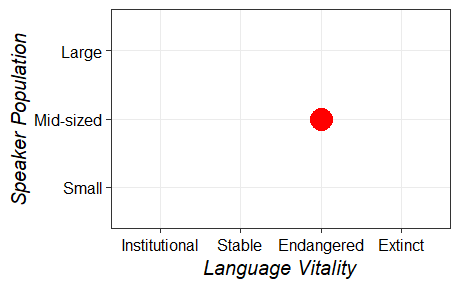 Click to enlarge with explanation
Place in Language Cloud
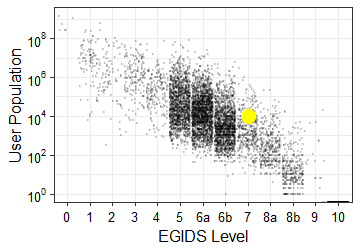 Click to enlarge with explanation