
FCS ISO 639-3
Quebec Sign Language
A language of Canada
- ISO 639
- fcs
- Alternate Names
- LSQ, Langue Signe Quebecars, Langue des signes, Langue des signes canadiens français, Langue des signes du Québec, Langue des signes québécoise, Québécoise
- Population
- 8,000 (2021 DBS/DOOR/SIL). Estimated 8,000 deaf signers, assuming 0.1% of the total population of Quebec. Other estimates vary widely: 5,000–6,000 (Parisot et al 2015), 50,000 (2010 E. Parks).
- Location:
- Scattered, especially in eastern provinces that are primarily Francophone: Quebec, eastern Ontario, New Brunswick, and Nova Scotia.
- Language Status
- 5 (Developing).
- Classification
- Sign language, Deaf community sign language
- Language Use
- Vigorous. Some use Signed French. Segregated deaf education by sex resulted in some lexical differences between the sexes; female use more influenced by ASL [ase], male by Signed French and LSF [fsl]. Rare for a deaf child to learn both LSQ and ASL. A few adults have working knowledge of both. Used by all. Some also use American Sign Language [ase], especially adults and a few children.
- Language Development
- Dictionary. Grammar. Agency: Societé Culturelle Québécoise des Sourds (SCQS).
- Other Comments
- No information on language used before 1831; LSQ arose in schools with influence from ASL [ase] and LSF [fsl]; the name ‘langue des signes québécois’ dates from the 1980s (Parisot et al 2015). In northern Quebec, Deaf people use American Sign Language [ase], with English as L2. Christian.
Also Spoken in
Map
Location: Scattered, especially in eastern provinces that are primarily Francophone: Quebec, eastern Ontario, New Brunswick, and Nova Scotia.
Size and Vitality
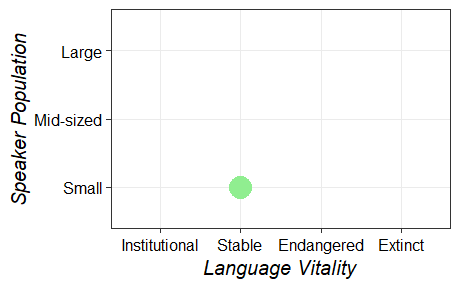 Click to enlarge with explanation
Place in Language Cloud
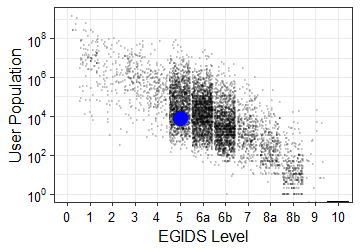 Click to enlarge with explanation