
ESY ISO 639-3
Eskayan
A language of Philippines
- ISO 639
- esy
- Alternate Names
- Bisayan Declarado, Bisayan Diklaradu, Bisayan-Eskaya, Eskaya’, Ineskaya, Iniskaya, Iskaya’
- Population
- 500, all users. L1 users: No known L1 speakers. L2 users: 500 (2013 P. Kelly). Ethnic population: 2,290 (2010 census).
- Location:
- Central Visayas region: Bohol province, Biabas, Cadapdapan, Canta-ub, Lundag, and Taytay villages.
- Language Status
- 9 (Dormant).
- Classification
- Mixed language, Cebuano-Spanish-English
- Dialects
- A constructed language created through a relexification of Boholano, a dialect of Cebuano [ceb], but with changes to affixation rules. Some lexical input from Cebuano, Spanish [spa], and English [eng] (Kelly 2012).
- Language Use
- Second language only. All speak Cebuano [ceb] as their L1. Religion, political events. Shifted to Cebuano [ceb]. Many also use Tagalog [tgl]. Some also use English [eng].
- Language Development
- Literature.
- Language Resources
- OLAC resources in and about Eskayan
- Writing
- Eskaya script [Qabr].
- Other Comments
- The earliest attested document in Eskayan is from 1908. The language is taught in traditional schools in Taytay and Biabas on Sundays. It is taught for 30 minutes each morning in the government elementary school in Taytay (2013 P. Kelly).
Also Spoken in
Map
Location: Central Visayas region: Bohol province, Biabas, Cadapdapan, Canta-ub, Lundag, and Taytay villages.
Size and Vitality
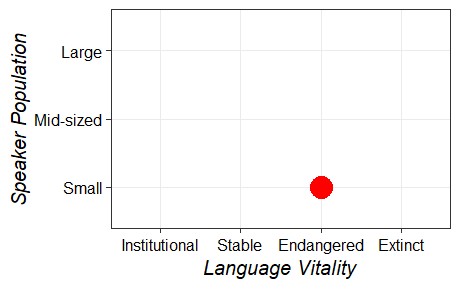 Click to enlarge with explanation
Place in Language Cloud
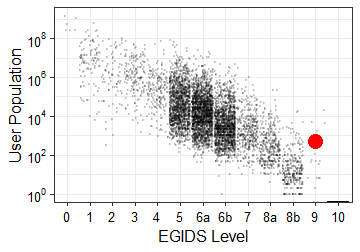 Click to enlarge with explanation