
ERS ISO 639-3
Ersu
A language of China
- ISO 639
- ers
- Alternate Names
- Bu’erci, Bu’erzi, Bu’erzi Ersu, Doxu, Duoxu, Erhsu, Lizu, Lusu, T’osu
- Population
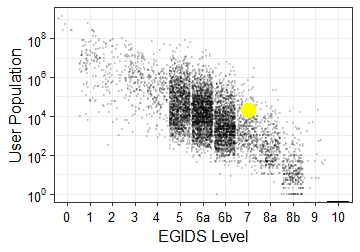
- 20,000 (Shearer and Sun 2002), decreasing. Eastern Ersu (Ersu) 13,000, Central Ersu (Duoxu) 10 or less, Western Ersu (Lizu) 4,000.
- Location:
- Sichuan province: Ganzi Tibetan autonomous prefecture, Jiulong county; Liangshan Yi autonomous prefecture, Ganluo, Mianning, Muli and Yuexi counties; Ya’an prefecture, Hanyuan and Shimian counties; all on lower Dadu river dispersed among Chinese, Tibetan, and Yi peoples.
- Language Status
- 7 (Shifting). Language of recognized nationality: Tibetan.
- Classification
- Sino-Tibetan, Tibeto-Burman, Northeastern Tibeto-Burman, Ersuish
- Dialects
- Ersu (Eastern Ersu), Duoxu (Central Ersu), Lisu (Liru, Lüzü, Western Ersu).
- Typology
- SOV; adjectives and number-classifier constructions follow noun heads; consonant cluster onsets; most morphemes monosyllabic; 2 tones, word-template zone.
- Language Use
- Decreasing from language attrition. Adults only. Neutral attitudes. Shifting to Mandarin Chinese [cmn]. A few also use Lipo [lpo]. Used as L2 by Namuyi [nmy].
- Language Development
- About 10 people can read the Shaba script. Videos. Grammar. Texts.
- Language Resources
- OLAC resources in and about Ersu
- Writing
- Ersu Shaba Picture Writing [Qaag], used until some time before 2003, limited usage, used in religious ceremonies.
- Other Comments
- Traditional religion.
Also Spoken in
Map
Location: Sichuan province: Ganzi Tibetan autonomous prefecture, Jiulong county; Liangshan Yi autonomous prefecture, Ganluo, Mianning, Muli and Yuexi counties; Ya’an prefecture, Hanyuan and Shimian counties; all on lower Dadu river dispersed among Chinese, Tibetan, and Yi peoples.
Size and Vitality
 Click to enlarge with explanation
Place in Language Cloud
 Click to enlarge with explanation