
ERO ISO 639-3
Horpa
A language of China
- ISO 639
- ero
- Alternate Names
- Bawang, Bopa, Danba, Daofu, Daofuhua, Dawu, Ergong, Geshitsa, Geshiza, Geshizahua, Hor, Huo’er, Hórsók, Nyagrong-Minyag, Pawang, Rgu, Western Gyarong, Western Jiarong, Xinlong-Muya, rTau, sTau
- Population
- 45,000 (Shearer and Sun 2002). sTau: 23,000, Geshitsa: 21,000, Nyagrong-Minyak: 1,000. 15,000 monolinguals.
- Location:
- Sichuan province: Ganzi (Garzê) Tibetan autonomous prefecture, Danba (Rong-brag), Daofu (rTau, sTau, Dawu), Luhuo, Xinlong (Brag-’go), and Xinlong (Nyagrong) counties.
- Language Status
- 6b (Threatened). Language of recognized nationality: Tibetan.
- Classification
- Sino-Tibetan, Tibeto-Burman, Northeastern Tibeto-Burman, rGyalrongic
- Dialects
- sTau (Daofu, Dawu, rTau), Geshitsa (Geshiza), Nyagrong-Minyag (Xinlong-Muya). The dialects of Horpa reportedly are not mutually intelligible.
- Typology
- SOV; adjectives and number-classifier constructions follow noun heads; affixation; compounding; reduplication; complex consonant cluster onsets; nontonal.
- Language Use
- All domains. Some young people, all adults. Neutral attitudes. Many also use Mandarin Chinese [cmn]. A few also use Central Tibetan [bod].
- Language Development
- Grammar.
- Language Resources
- OLAC resources in and about Horpa
- Writing
- Unwritten [Qaax].
- Other Comments
- Buddhist.
Also Spoken in
Map
Location: Sichuan province: Ganzi (Garzê) Tibetan autonomous prefecture, Danba (Rong-brag), Daofu (rTau, sTau, Dawu), Luhuo, Xinlong (Brag-’go), and Xinlong (Nyagrong) counties.
Size and Vitality
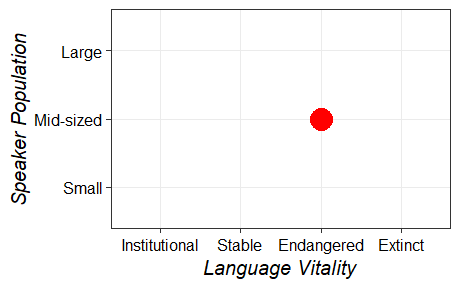 Click to enlarge with explanation
Place in Language Cloud
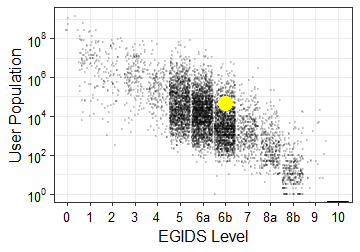 Click to enlarge with explanation