
EPO ISO 639-3
Esperanto
Esperanto, Lingvo Internacia Autonym
A language of Poland
- ISO 639
- epo
- Autonym
- Esperanto, Lingvo Internacia
- Population
- 101,000, all users. L1 users: 1,000 (Corsetti et al 2004), increasing. L2 users: 100,000 (2017 S.V. Nielsen).
- Location:
- Scattered internationally. Most widely represented in Japan, China, France, Germany, Italy, Poland, United States, Brazil, Belgium, and United Kingdom (in order of number of members in the World Esperanto Association).
- Language Status
- 3 (Wider communication). LWC on an international level. Esperanto was developed for intercommunication among L1 users of other languages. It is currently used by speakers in over 100 countries of the world.
- Classification
- Constructed language
- Typology
- SVO; prepositions; genitives, relatives after noun heads; articles, adjectives, numerals before noun heads; question word initial; definite article; case-marking (2 cases); passives; tense; comparative word; 23 consonant and 5 vowel phonemes; non-tonal; stress on penultimate syllable.
- Language Use
- L1 users learn Esperanto from birth from Esperanto-speaking parents. Home, Esperanto clubs and associations. Used by all. Positive attitudes.
- Language Development
- Literature. Periodicals. Radio. Videos. Dictionary. Grammar. Bible: 1926. Agency: World Esperanto Association.
- Language Resources
- OLAC resources in and about Esperanto
- Writing
- Latin script [Latn].
- Other Comments
- Non-indigenous. Most widely used constructed language in the world. Developed 1887 by L. L. Zamenhof, a Polish ophthalmologist. For this reason, Poland has been selected as the primary country for Esperanto.
Also Spoken in
Map
Location: Scattered internationally. Most widely represented in Japan, China, France, Germany, Italy, Poland, United States, Brazil, Belgium, and United Kingdom (in order of number of members in the World Esperanto Association).
Size and Vitality
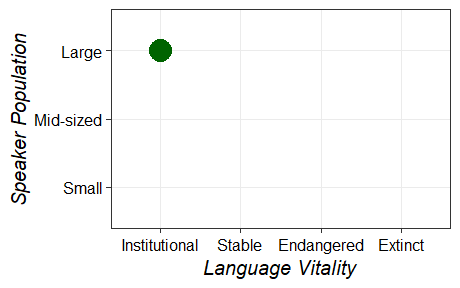 Click to enlarge with explanation
Place in Language Cloud
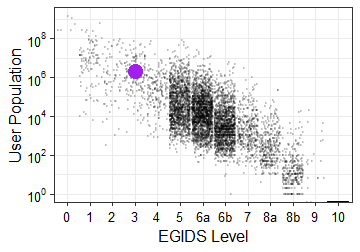 Click to enlarge with explanation