
DRD ISO 639-3
Darmiya
A language of India
- ISO 639
- drd
- Alternate Names
- Darimiya, Darma, Darma Lwo, Darma-Lwo, Darmani, Saukas, Shaukas
- Population
- 1,750 (2006 C. Willis). Ethnic population: 4,000.
- Location:
- Uttarakhand state: Pithoragarh district, Darchula and Munsyari sub-district, Baling, Baun, Bongling, Dar, Datu, Dhakar, Dugtu, Gwo, Marchha, Nanglin, Philam, Saung, Selachal, Sipoo, and Sobla villages; in Dhauli valley, from Tawaghat near Dharchula south to Sipoo north along Dhauli river.
- Language Status
- 6b (Threatened).
- Classification
- Sino-Tibetan, Tibeto-Burman, Western Tibeto-Burman, Bodish, West Himalayish, Almora
- Dialects
- None known. Related to Rangkas [rgk], Chaudangsi [cdn] and Byangsi [bee].
- Language Use
- Learn Kumaoni [kfy] and Hindi [hin] simultaneously with their mother tongue. Code switching and code mixing very common. Uncertain whether stable bilingualism will continue or whether Kumaoni or Hindi will replace Darmiya. Home, community. Some young people, all adults. Also use Central Tibetan [bod]. Also use English [eng]. Also use Hindi [hin], with high rates of bilingualism and as the medium of education at all levels. Also use Kumaoni [kfy]. Also use Nepali [npi].
- Language Development
- Grammar.
- Language Resources
- OLAC resources in and about Darmiya
- Writing
- Unwritten [Qaax].
- Other Comments
- Ranglo or Rang often used for Byangs, Chaudangs, Darmiya, and Rongpo. Hindu, traditional religion.
Also Spoken in
Map
Location: Uttarakhand state: Pithoragarh district, Darchula and Munsyari sub-district, Baling, Baun, Bongling, Dar, Datu, Dhakar, Dugtu, Gwo, Marchha, Nanglin, Philam, Saung, Selachal, Sipoo, and Sobla villages; in Dhauli valley, from Tawaghat near Dharchula south to Sipoo north along Dhauli river.
Size and Vitality
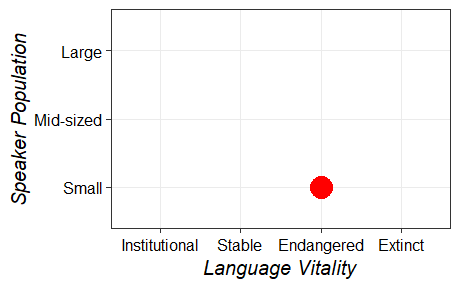 Click to enlarge with explanation
Place in Language Cloud
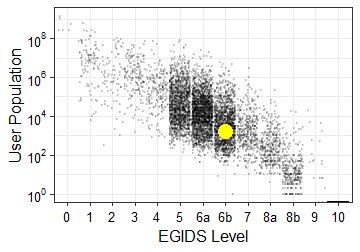 Click to enlarge with explanation