
DGR ISO 639-3
Tlicho
Tłı̨chǫ Yatıì Autonym
A language of Canada
- ISO 639
- dgr
- Alternate Names
- Dogrib, Flanc-de-chien, Tłı̨chǫ, Thlingchadine
- Autonym
- Tłı̨chǫ Yatıì
- Population
- 1,650 (2016 census). 250 monolinguals. Ethnic population: 3,220 (2018).
- Location:
- Northwest Territories, between Great Slave lake and Great Bear lake. 6 communities: Bechoko, Whati (formerly Lac la Martre), Gameti, Wekweti, Detah, and Ndilo (a subcommunity of Yellowknife). Rae is center. Detah and Ndilo host the Weledeh dialect.
- Language Status
- 6b (Threatened). Statutory language of provincial identity in NWT (1988, NWT Official Languages Act, Chapter 56 (Supplemented), Section 4), restricted offical use. Language of recognized indigenous peoples: Dechi Laot’i, Dog Rib Rae, Gameti, Wha Ti, Yellowknives Dene.
- Classification
- Eyak-Athabaskan, Athabaskan, Northern Athabaskan
- Dialects
- Weledeh, Central Dogrib. Detah-Ndilo dialect developed from intermarriage between Yellowknife Subdivision of the Dëne [chp] and Tlicho. Lexical similarity: 84% with Southern Slavey [xsl], 82% with Northern Slavey [scs].
- Typology
- SOV.
- Language Use
- Adults prefer to use Tlicho in most contexts. Some young people, all adults. All also use English [eng].
- Language Development
- Literacy rate in L1: 1%–5%. Literacy rate in L2: 25%–50%. Taught in primary schools. Literature. Dictionary. NT: 2005–2008.
- Language Resources
- OLAC resources in and about Tlicho
- Writing
- Latin script [Latn].
Also Spoken in
Map
Location: Northwest Territories, between Great Slave lake and Great Bear lake. 6 communities: Bechoko, Whati (formerly Lac la Martre), Gameti, Wekweti, Detah, and Ndilo (a subcommunity of Yellowknife). Rae is center. Detah and Ndilo host the Weledeh dialect.
Size and Vitality
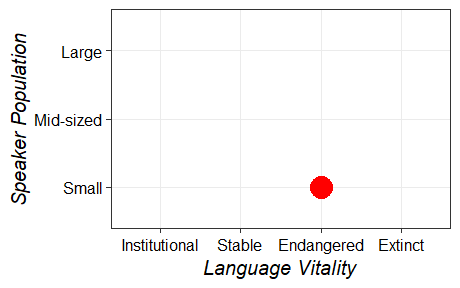 Click to enlarge with explanation
Place in Language Cloud
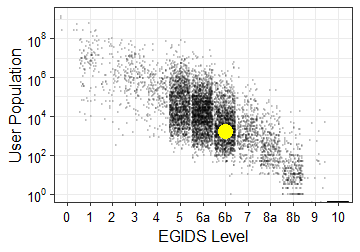 Click to enlarge with explanation