
CSR ISO 639-3
Costa Rican Sign Language
A language of Costa Rica
- ISO 639
- csr
- Alternate Names
- LESCO, Lengua de Señas Costarricense, Lenguaje de Señas Costarricense
- Population
- 15,000 in Costa Rica (2021 DBS/DOOR/SIL). Estimated 10,000–20,000 deaf signers, assuming 0.2%–0.4% of the general population; 70,700 people with hearing loss (2011 census).
- Location:
- Scattered.
- Language Status
- 5 (Developing). Recognized language (2012, Ley 9049, Official Recognition of Costa Rican Sign Language). Recognized language (2020, Law 9822 Recognition and promotion of Lenguaje de Señas Costarricense (LESCO)).
- Classification
- Sign language, Deaf community sign language
- Dialects
- New Costa Rican Sign Language (Modern Costa Rican Sign Language, NCRSL), Original Costa Rican Sign Language (OCRSL). Older and younger dialects differ due to influence from American Sign Language (ASL) [ase] starting in the 1970s (2008 C. Ramirez); younger signers not familiar with the older variety cannot understand it well (2013 A. Olviedo). Younger variety has 63% probable cognates with ASL [ase] on a 100-word modified Swadesh word list; older variety only 27% (Woodward 2011).
- Language Use
- Vigorous. Used by all. Also use Spanish [spa].
- Language Development
- Taught in primary schools. Dictionary. Agency: Asociación Nacional de Sordos (ANASCOR).
- Other Comments
- From 1940 onward education was oralist, but changed to Total Communication in 1974; use of LESCO in the classroom started in the early 2000s. Interpreter training at the Universidad de Costa Rica. (2013 A. Oviedo). Two other sign languages among indigenous groups in the south (the Bribri and Boruca), apparently unrelated to LESCO (Woodward 1991).
Also Spoken in
- Location
- Eastern region, particularly San Miguel (Ciupek-Reed 2012).
- Language Status
- 6b (Threatened)
- Other Comments
- Non-indigenous. Schools in the east use Salvadoran Sign Language (LESSA) [esn], which has more prestige than LESCO (Ciupek-Reed 2012). View other languages of El Salvador
Language Name
Costa Rican Sign Language
Map
Location: Scattered.
Size and Vitality
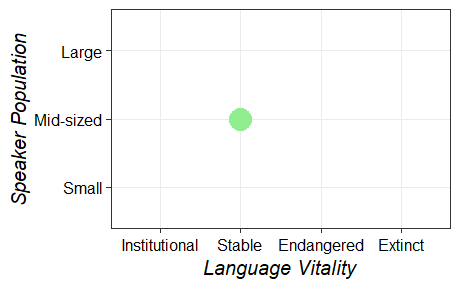 Click to enlarge with explanation
Place in Language Cloud
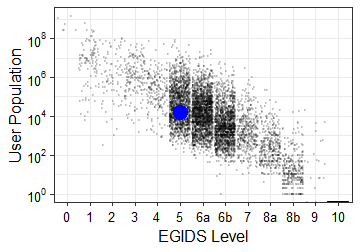 Click to enlarge with explanation