
CSG ISO 639-3
Chilean Sign Language
A language of Chile
- ISO 639
- csg
- Alternate Names
- LENSE, LSCh, Lengua de Señas Chilena, Lenguaje Chileno de Signos, Lenguaje de Señas
- Population
- 21,000 (Parks et al 2011a). 292,700 people with some level of auditory deficiency (2005 Fondo Nacional de la Discapacidad); 66,500 people with total deafness (23,900 less than 60 years old) (2002 census); others give estimates as high as 500,000 users (2018 J. Atala).
- Location:
- Scattered.
- Language Status
- 5 (Developing). Recognized language (2010, Article 26 of Law No. 20.422), recognizes sign language as the natural means of communication of the Deaf community.
- Classification
- Sign language, Deaf community sign language
- Dialects
- Variation based on region (northern, central, and southern), age, and educational background. Regional varieties are influenced by bordering countries. (Parks et al 2011a).
- Language Use
- All domains. Used by all. Positive attitudes. Favor use by both Deaf and hearing people. Also use Spanish [spa], with varying degrees of bilingualism in speech and writing. Literacy for access to mainstream society and employment is valued.
- Language Development
- First residential school for the Deaf opened in 1852 in Santiago. Oralist education predominated from 1889 to the 1980s, when schools began incorporating signing, chiefly Total Communication, but sometimes a bilingual-bicultural approach. Currently, most deaf students attend mainstream schools. Almost 60% of Chilean deaf have no education beyond primary school; only 3.4% have graduated from high school (González et al 2019). 37 Deaf teachers of Chilean sign language (2006 V. Castillo Martínez). Approximately 15 sign language interpreters (2008 WFD). TV. Dictionary. Texts. Agency: Asociación de Sordos de Chile (ASOCH).
- Other Comments
- Interpretation and subtitling is mandated for television under Article 25 of Law No. 20.422.
Also Spoken in
Map
Location: Scattered.
Size and Vitality
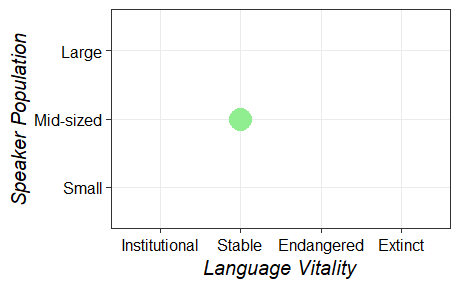 Click to enlarge with explanation
Place in Language Cloud
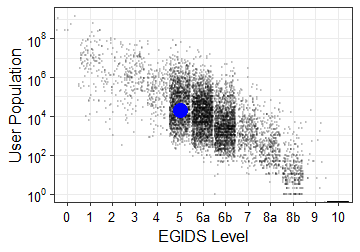 Click to enlarge with explanation