
CHP ISO 639-3
Dene
Dënesųłıné Autonym
A language of Canada
- ISO 639
- chp
- Alternate Names
- Dëne Súline, “Chipewyan” (pej.)
- Autonym
- Dënesųłıné
- Population
- 10,700 (2016 census).
- Location:
- Northern Alberta, Saskatchewan, Manitoba, southeastern Northwest Territories (Snowdrift and Fort Resolution), Fort Smith, Fort Chipewyan, Wolliston Post, Buffalo Narrows, Brochet, and some communities in Reindeer Lake.
- Language Status
- 6b* (Threatened). Recognized language (1988, NWT Official Languages Act, Chapter 56 (Supplemented), Section 4), restricted official use. Language of recognized indigenous peoples: Athabasca Chipewyan, Barren Lands, Birch Narrows, Black Lake, Buffalo River Dene, Chipewyan Prairie, Clearwater River Dene, Cold Lake, Deninu K’ue, English River, Fond du Lac, Fort McKay, Fort McMurray, Hatchet Lake, K’atlodeeche, Lutsel K’e Dene, Northlands Denesuline, Salt River, Sayisi Dene, Smith’s Landing, Yellowknives Dene.
- Classification
- Eyak-Athabaskan, Athabaskan, Northern Athabaskan
- Dialects
- Yellowknife.
- Language Use
- Very few readers of Dëne. In La Loche some children still learn Dëne. Proportion of speakers much higher in some remote areas where some children are more fluent in Dëne than English [eng]. All also use English [eng].
- Language Development
- Literacy rate in L1: 1%–5%. Literacy rate in L2: 25%–50%. Dictionary. Grammar. Texts. NT: 1881.
- Language Resources
- OLAC resources in and about Dene
- Writing
- Latin script [Latn]. Unified Canadian Aboriginal Syllabics script [Cans], no longer in use.
Also Spoken in
Map
Location: Northern Alberta, Saskatchewan, Manitoba, southeastern Northwest Territories (Snowdrift and Fort Resolution), Fort Smith, Fort Chipewyan, Wolliston Post, Buffalo Narrows, Brochet, and some communities in Reindeer Lake.
Size and Vitality
 Click to enlarge with explanation
Place in Language Cloud
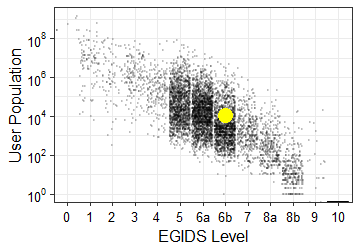 Click to enlarge with explanation