
CBN ISO 639-3
Nyahkur
ญัฮกุ้ร (Nyah Kur), เนียะกวล (Niakuol) Autonym
A language of Thailand
- ISO 639
- cbn
- Alternate Names
- Chao Dong, Chaodon, Lawa, Niakuol, Niakuoll, Nyah Kur, Nyakur, “Chaobon” (pej.), “Chaobun” (pej.), “Chaubun” (pej.)
- Autonym
- ญัฮกุ้ร (Nyah Kur), เนียะกวล (Niakuol)
- Population
- 1,500 (2006 C. Shimmin), decreasing. No monolinguals. It appears the last monolingual speakers likely died out no later than the 1950s (2017 C. Shimmin). Ethnic population: 3,000 (Thongkum 1984).
- Location:
- Bueng Kan, Chaiyaphum, Kalasin, Nakhon Ratchasima, Phetchabun, Phitsanulok, and Sakon Nakhon provinces.
- Language Status
- 7 (Shifting).
- Classification
- Austro-Asiatic, Mon-Khmer, Southern Monic
- Dialects
- Chaiyaphum users say they understand Phetchabun only with difficulty, if at all. At least 91% lexical similarity among all dialects (Diffloth 1984).
- Typology
- SVO.
- Language Use
- Few children can speak Nyah Kur. Nearly extinct in Phetchabun and Nakhon Ratchasima provinces (2007 SIL). Home. Adults only. Mixed attitudes. Some have strong identity links to their language, others prefer to identify themselves as Thai [tha] (2002 P. Suwilai, 2007 SIL). Shifting to Thai [tha]. Some also use Northeastern Thai [tts] (Statezni et al 2007). Also use Lao [lao].
- Language Development
- Literacy rate in L1: 1%. Literacy rate in L2: 75%. Most men and the younger generation are literate in Thai [tha]. Literacy in Thai [tha] transfers easily to Nyah Kur. Dictionary. Grammar. Texts. Bible portions: 1996.
- Language Resources
- OLAC resources in and about Nyahkur
- Writing
- Thai script [Thai].
- Other Comments
- Buddhist, Christian, traditional religion.
Also Spoken in
Map
Location: Bueng Kan, Chaiyaphum, Kalasin, Nakhon Ratchasima, Phetchabun, Phitsanulok, and Sakon Nakhon provinces.
Size and Vitality
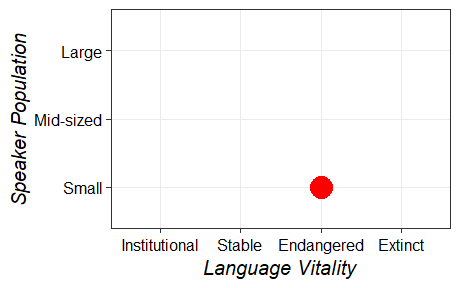 Click to enlarge with explanation
Place in Language Cloud
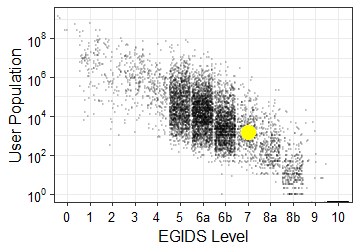 Click to enlarge with explanation