
CAT ISO 639-3
Catalan
Català Autonym
A language of Spain
- ISO 639
- cat
- Alternate Names
- Catalan-Valencian-Balear, Catalonian, Catalán, Valencian
- Autonym
- Català
- Population
- 8,810,000 in Spain, all users. L1 users: 3,710,000 in Spain (European Commission 2012). L2 users: 5,100,000 (European Commission 2012). Total users in all countries: 9,241,310 (as L1: 4,141,310; as L2: 5,100,000).
- Location:
- Aragon, Balearic Islands, Catalonia, and Valencia autonomous communities; Murcia autonomous community: Carche region.
- Language Status
- 2 (Provincial). Statutory provincial language in Catalonia Autonomous Community (1979, Autonomy Act, No. 4, Article 3(2,5)). Statutory provincial language in Valencia Autonomous Community (1982, Autonomy Act, No. 9, Article 7), called Valencian in local laws. Statutory provincial language in Aragon Autonomous Community (1982, Autonomy Act, No. 8, Article 7), called LAPAO (Eastern Aragonese) in local laws. Statutory provincial language in Balearic Islands (1983, Statute of Autonomy of the Balearic Islands, No. 2, Article 3(3)).
- Classification
- Indo-European, Italic, Romance, Italo-Western, Western, Gallo-Iberian, Ibero-Romance, East Iberian
- Dialects
- Catalan-Rousillonese (Northern Catalan), Valencian (Valenciano, Valencià), Balearic (Balear, Eivissenc, Insular Catalan, Mallorqui, Menorqui, Menorquin), Central Catalan, Northwestern Catalan (Aiguavivan, Eastern Aragonese, Lleidatà, Pallarese, Ribagorçan). Standardized variety is a literary composite of several dialects and written form is most similar to Barcelona speech. Pallarese and Ribogorçan dialects less similar to standard Catalan. Benasquese and Aiguavivan people live in isolated valleys and have distinct phonology from their neighbors. Tortosin may be more similar to Valencian. Central Catalan has 90% to 95% inherent intelligibility for speakers of Valencian (1989 R. Hall, Jr.). Lexical similarity: 87% with Italian [ita], 85% with Portuguese [por] and Spanish [spa], 76% with Ladin [lld] and Romansh [roh], 75% with Sardinian [src], 73% with Romanian [ron].
- Typology
- SVO; prepositions; most attributive adjectives come after noun, numbers and possessives before the noun; gender (masculine/feminine); definite and indefinite articles; verb affixes mark person, number; passives; tense; comparatives; 22 consonants, 7 vowels, 4 diphthongs; non-tonal; stress on penultimate syllable.
- Language Use
- All domains. Used by all. Also use French [fra]. Also use Italian [ita]. Also use Logudorese Sardinian [src]. Also use Occitan [oci]. Also use Spanish [spa]. Used as L2 by Aranese Gascon [oci], Catalan Sign Language [csc].
- Language Development
- Literacy rate in L1: 60%. Literacy rate in L2: 96%. High literacy in Catalan (60%) is recent. Pallarese and Ribogorçan speakers have less education, less contact with the standard, and live in high valleys of the Pyrenees. Some Valencian desire separate literature. Radio. TV. Dictionary. Grammar. Texts. Bible: 1478–1993. Agency: Institut d’Estudis Catalans (Institute of Catalan Studies), Acadèmia Valenciana de la Llengua (Royal Academy of the Valencian Language).
- Language Resources
- OLAC resources in and about Catalan
- Writing
- Latin script [Latn].
- Other Comments
- Christian.
Also Spoken in
- Language Status
- 1 (National)
- Other Comments
- Christian. View other languages of Andorra
Language Name
Catalan
User Population
30,000 in Andorra (2005 census).
- Language Status
- Unestablished
- Other Comments
- Non-indigenous. View other languages of Argentina
Language Name
Catalan
User Population
198,000 in Argentina (2018). , based on nationality.
- Language Status
- Unestablished
- Other Comments
- Non-indigenous. View other languages of Cuba
Language Name
Catalan
User Population
3,500 in Cuba (2004).
- Location
- Occitania region: Pyrenees-Orientales department.
- Language Status
- 5 (Dispersed) View other languages of France
Language Name
Catalan
User Population
126,000 in France (2013).
- Location
- Sardinia region: Sassari province, Alghero city.
- Dialects
- Alghero (Algherese).
- Language Status
- 4 (Educational)
- Other Comments
- Non-indigenous. Once part of the ancient Arago-Catalan kingdom, now a linguistic enclave in the municipality of Alghero (Argenter 2008). View other languages of Italy
Language Name
Catalan
User Population
7,480 in Italy (Argenter 2008).
- Language Status
- Unestablished
- Other Comments
- Non-indigenous. View other languages of Mexico
Language Name
Catalan
User Population
64,000 in Mexico (2021 Joshua Project). , based on ethnicity.
- Language Status
- Unestablished
- Other Comments
- Non-indigenous. View other languages of United States
Language Name
Catalan
User Population
2,330 in United States (2015 census). Language identified in census as Catalonian.
Map
Location: Aragon, Balearic Islands, Catalonia, and Valencia autonomous communities; Murcia autonomous community: Carche region.
Size and Vitality
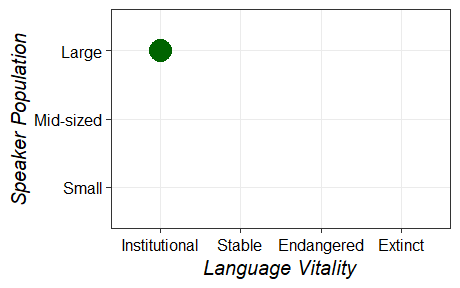 Click to enlarge with explanation
Place in Language Cloud
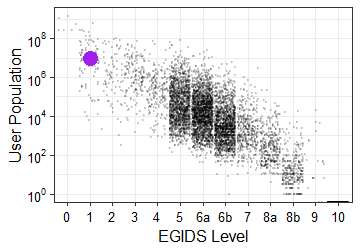 Click to enlarge with explanation