
BXR ISO 639-3
Buriat, Russia
буряад хэлэн (buryaad xelen) Autonym
A language of Russian Federation
- ISO 639
- bxr
- Alternate Names
- Buriat-Mongolian, Buryat, Northern Mongolian
- Autonym
- буряад хэлэн (buryaad xelen)
- Population
- 219,000 (2010 census). Ethnic population: 461,000 (2010 census).
- Location:
- Buryatia republic; Irkutsk province; Zabaykalsky krai; Siberia, east of Lake Baikal, Mongolia border.
- Language Status
- 2 (Provincial). Statutory provincial language in Buryatia Republic (1994, Constitution of the Republic of Buryatia, Article 67).
- Classification
- Mongolic, Eastern, Oirat-Khalkha, Khalkha-Buriat, Buriat
- Dialects
- Ekhirit-Bulagat, Selengin, Unga, Ninzne-Udinsk, Barguzin, Tunka, Oka, Alar, Bohaan, Bokhan, Khori. Less influenced by Russian [rus] east of Lake Baikal; more similar to Mongolia. Literary dialect differs considerably from those in Mongolia and China, which are influenced by other languages. Khori is the main dialect in the Russian Federation. Speakers in Russian Federation appear to understand each other well. A member of macrolanguage Buriat [bua].
- Language Use
- Children in rural areas usually learn Buriat, but in cities Russian [rus] is often spoken even between Buriat speakers (Salminen 2007). Home, community. Used by all. Neutral attitudes. Most also use Russian [rus], especially younger people in the cities. Used as L2 by Evenki [evn].
- Language Development
- Those on both sides of Lake Baikal are fully literate in the literary variety. Literature. Newspapers. Dictionary. Grammar. Bible: 1846.
- Language Resources
- OLAC resources in and about Buriat, Russia
- Writing
- Cyrillic script [Cyrl].
- Other Comments
- Heavily influenced by Russian [rus]. Buddhist, traditional religion.
Also Spoken in
Map
Location: Buryatia republic; Irkutsk province; Zabaykalsky krai; Siberia, east of Lake Baikal, Mongolia border.
Size and Vitality
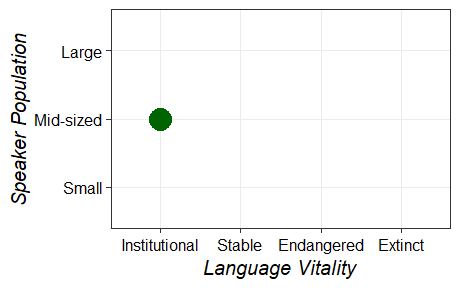 Click to enlarge with explanation
Place in Language Cloud
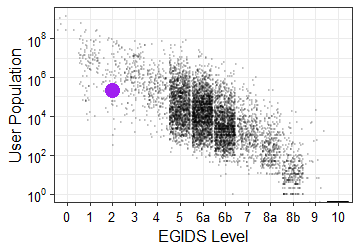 Click to enlarge with explanation