
BKM ISO 639-3
Kom
Itangikom Autonym
A language of Cameroon
- ISO 639
- bkm
- Alternate Names
- Bamekon, Bikom, Kong, Nkom
- Autonym
- Itangikom
- Population
- 233,000 (2005 CABTAL), increasing. 69,900 monolinguals. Ethnic population: 233,000.
- Location:
- North West region: south Boyo division, southeast of Wum town, northeast of Bamenda city; also major urban centers.
- Language Status
- 3 (Wider communication). Originated in Cameroon. Today used as a church language and/or in other domains by nine language groups.
- Classification
- Niger-Congo, Atlantic-Congo, Volta-Congo, Benue-Congo, Bantoid, Southern, Wide Grassfields, Narrow Grassfields, Ring, Center
- Typology
- Tonal.
- Language Use
- Vigorous. All domains. Oral use in local administration, church, commerce, written use in church, letters. Used by all. Positive attitudes. Most also use Cameroon Pidgin [wes]. Some also use English [eng]. Some also use Lamnso’ [lns]. A few also use Babanki [bbk]. A few also use Bum [bmv]. A few also use Chungmboko [cug]. A few also use French [fra]. A few also use Mmen [bfm]. A few also use Oku [oku]. Used as L2 by Aghem [agq], Babanki [bbk], Bum [bmv], Chungmboko [cug], Kemedzung [dmo], Laimbue [lmx], Mmen [bfm], Noone [nhu].
- Language Development
- Literacy rate in L1: 10%. Literacy rate in L2: 30%. First Kom alphabet developed by German missionaries in 1880s. 5% can write Kom. 35 out of 90 schools have bilingual education. A few high schools have Kom language clubs, and Kom is a subject in extracurricular activities. Literature. Radio. Dictionary. Texts. NT: 2004. Agency: Kom Language Development Committee.
- Language Resources
- OLAC resources in and about Kom
- Writing
- Latin script [Latn].
- Other Comments
- Christian, traditional religion.
Also Spoken in
Map
Location: North West region: south Boyo division, southeast of Wum town, northeast of Bamenda city; also major urban centers.
Size and Vitality
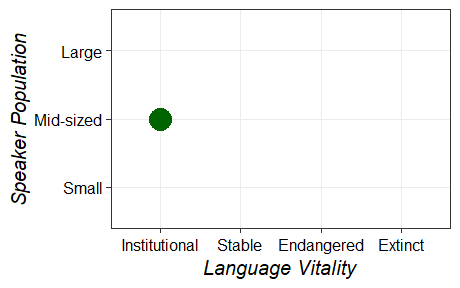 Click to enlarge with explanation
Place in Language Cloud
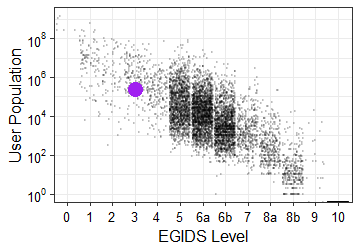 Click to enlarge with explanation