
BHJ ISO 639-3
Bahing
बाहिङ (bahing) Autonym
A language of Nepal
- ISO 639
- bhj
- Alternate Names
- Baying, Bayung, Ikke lo, Kiranti-Bayung, Pai lo, Radu lo, Rai
- Autonym
- बाहिङ (bahing)
- Population
- 15,250, all users. L1 users: 11,700 (2011 census). L2 users: 3,550 (2011 census).
- Location:
- Kosi province: Khotang district, Halesi Tuwachung municipality; Okhaldhunga district, Chisankhugadhi, Manebhanjyang, Molung, Siddhicharan, and Sunkoshi municipalities; Solukhumbu district: Nechasalyan municipality.
- Language Status
- 5 (Developing). Language of recognized indigenous nationality: Rai.
- Classification
- Sino-Tibetan, Tibeto-Burman, Western Tibeto-Burman, Himalayan, Kiranti, Western
- Dialects
- Rumdali, Nechali, Tolacha, Moblocha, Hangu. 85% or above intelligibility among all dialects. Rumdali is best understood among all Bahing dialects (Lee et al 2005). Related to Sunwar [suz]. Lexical similarity: 83%–95% with dialects, 48% with Sunwar [suz] (Lee et al 2005).
- Typology
- SOV.
- Language Use
- Reportedly still used often by younger generation. Shift to Nepali [npi] relatively low (Winter and Hansson 1991); High vitality (Lee et al 2005). Home, friends, religion, work. Used by all. Positive attitudes. Many also use Nepali [npi] (Lee et al 2005). Used as L2 by Bantawa [bap], Nepali [npi], Thulung [tdh], Wambule [wme].
- Language Development
- Bahing orthography introduced through community-based development efforts. Two books published (2009). Bahing orthography being promoted for use by the whole Bahing community. Literature. Periodicals. Radio. NT: 2016. Agency: Bahing Kirat Mulukhim.
- Language Resources
- OLAC resources in and about Bahing
- Writing
- Devanagari script [Deva].
- Other Comments
- Traditional religion, Christian, Hindu.
Also Spoken in
Map
Location: Kosi province: Khotang district, Halesi Tuwachung municipality; Okhaldhunga district, Chisankhugadhi, Manebhanjyang, Molung, Siddhicharan, and Sunkoshi municipalities; Solukhumbu district: Nechasalyan municipality.
Size and Vitality
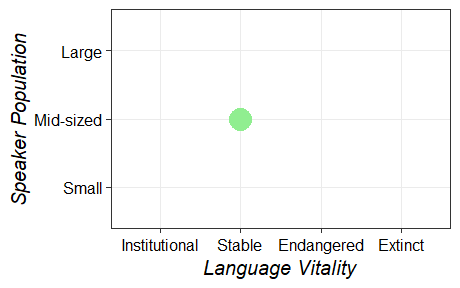 Click to enlarge with explanation
Place in Language Cloud
 Click to enlarge with explanation