
BGG ISO 639-3
Bugun
Bugun Autonym
A language of India
- ISO 639
- bgg
- Alternate Names
- Kho, Khoa, Khowa
- Autonym
- Bugun
- Population
- 900 (2001 Asia Harvest).
- Location:
- Arunachal Pradesh state: West Kameng district, Nafra and Singchung sub-districts, Bichom, Diching, Dikiang, Lichini, Mangopom, Namphri, New Kaspi, Ramu, Sachita, Singchung, Situ, and Wangho villages; in mountains on both sides of Rupa river, interspersed among the Aka.
- Language Status
- 6b* (Threatened).
- Classification
- Sino-Tibetan, Tibeto-Burman, Central Tibeto-Burman, Kho-Bwa
- Dialects
- None known. May be mutually intelligible with Puroik [suv] (Chowdhury 1996); Burling (2003) groups it with Puroik and Sherdukpen [sdp] and possibly also with Lish [lsh] and Sartang [onp]. Lexical similarity: low with all neighboring languages.
- Language Use
- Home, village, religion. Also use English [eng]. Also use Hindi [hin]. Younger people use more Hindi. Also use Hruso [hru]. Also use Kalaktang Monpa [kkf]. Also use Nefamese [nef]. Also use Sherdukpen [sdp]. Older people use more Sherdukpen.
- Language Development
- Literacy rate in L2: 24% (1981 census), 35% for men, 12% for women. NT: 2018.
- Language Resources
- OLAC resources in and about Bugun
- Writing
- Latin script [Latn].
- Other Comments
- Spoken by the Khoa (Khowa) ethnic group. They are culturally like the Hruso, but speak a different language. Traditional religion, Buddhist.
Also Spoken in
Map
Location: Arunachal Pradesh state: West Kameng district, Nafra and Singchung sub-districts, Bichom, Diching, Dikiang, Lichini, Mangopom, Namphri, New Kaspi, Ramu, Sachita, Singchung, Situ, and Wangho villages; in mountains on both sides of Rupa river, interspersed among the Aka.
Size and Vitality
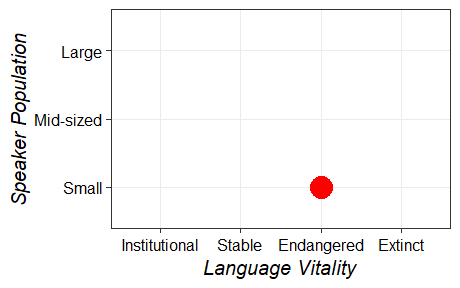 Click to enlarge with explanation
Place in Language Cloud
 Click to enlarge with explanation