
BBJ ISO 639-3
Ghomálá’
Ghomálá’ Autonym
A language of Cameroon
- ISO 639
- bbj
- Alternate Names
- Baloum, Bamileke-Bandjoun, Bandjoun, Banjoun-Baham, Banjun, Batie, Mahum, Mandju, ghᴐmala’
- Autonym
- Ghomálá’
- Population
- 350,000 (2005 SIL). Based on the actual population of the subdivisions where the Ghomala’ people are present, as of the official 2005 census (2014 C. Hamm).
- Location:
- West region: some in south Bamboutos division, east Menoua division, Mifi division except south and pockets north and west, Bamendjou subdivision.
- Language Status
- 5* (Developing).
- Classification
- Niger-Congo, Atlantic-Congo, Volta-Congo, Benue-Congo, Bantoid, Southern, Wide Grassfields, Narrow Grassfields, Mbam-Nkam, Bamileke
- Dialects
- Ghomálá’ Central (Baham, Bandjoun, Hom, Jo, We, Yogam), Ghomálá’ North (Fusap, Lang), Ghomálá’ South (Dengkwop, Pa, Te), Ngemba (Bamenjou, Fu’da, Meka, Monjo, Mugum, Sa). Bameka, Bansoa, and Balessing are subvarieties of South Ghomálá’, North Ghomálá’ has 2 subvarieties, Central Ghomálá’ 4, and Ngemba 5.
- Language Use
- Taught informally to adults since the early 1900s. Adopted by UNESCO in 1960s as one of 9 languages of wider communication for Cameroon. Taught formally in 6 Roman Catholic schools since 1995. Most also use French [fra]. A few also use Bamun [bax]. A few also use Cameroon Pidgin [wes]. A few also use English [eng]. A few also use Medumba [byv]. Used as L2 by Fe’fe’ [fmp].
- Language Development
- Literacy rate in L2: 25%–50%. Dictionary. Grammar. NT: 2002.
- Language Resources
- OLAC resources in and about Ghomálá’
- Writing
- Latin script [Latn].
- Other Comments
- Traditional religion, Christian.
Also Spoken in
Map
Location: West region: some in south Bamboutos division, east Menoua division, Mifi division except south and pockets north and west, Bamendjou subdivision.
Size and Vitality
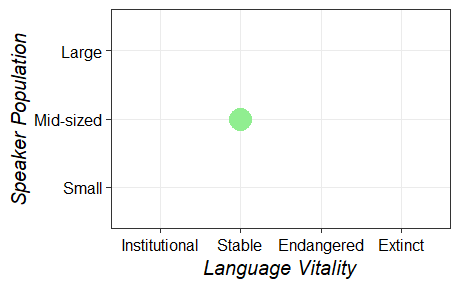 Click to enlarge with explanation
Place in Language Cloud
 Click to enlarge with explanation