
AJZ ISO 639-3
Amri Karbi
Amri Karbi Autonym
A language of India
- ISO 639
- ajz
- Alternate Names
- Amri
- Autonym
- Amri Karbi
- Population
- 125,000 (2003).
- Location:
- Assam state: Kamrup district, Basbistha, Chandubi, Jalukbari, Jorabat, Kahi Kusi, Khetri, Loharghat, Pandu, Panikhaith, Rani block, Sonapur, and south of Brahmaputra river; Meghalaya state: Ri-Bhoi district, Nongpoh area, Barni Hat and Umling.
- Language Status
- 6b (Threatened).
- Classification
- Sino-Tibetan, Tibeto-Burman, Karbi
- Dialects
- Lower Amri, Upper Amri. Reportedly unintelligible with Karbi [mjw]; intelligibility testing inconclusive regarding whether Guriaghuli area dialect is well understood in Meghalaya. Lexical similarity: 57%–68% with Karbi; 70%–86% between dialects.
- Language Use
- Many ethnic group members no longer use Amri Karbi. Much borrowing from Assamese [asm] (in Assam) and Khasi [kha] (in Meghalaya). Some Amri Karbi villages shifted completely to Assamese due to intermarriage and the perception that Assamese is preferred for children to do well in school. In the remote and isolated border area, the language is still strong. Home, village, religion. Some of all ages. Positive attitudes. Strong feelings of separateness from the dominant Karbi group in Karbi, Anglong District. Most also use Assamese [asm]. Many also use English [eng].
- Language Development
- Literacy rate in L2: 20%—60%. Literature. Newspapers. Radio. Grammar. NT: 2010.
- Language Resources
- OLAC resources in and about Amri Karbi
- Writing
- Latin script [Latn].
- Other Comments
- Hindu, Christian, traditional religion.
Also Spoken in
Map
Location: Assam state: Kamrup district, Basbistha, Chandubi, Jalukbari, Jorabat, Kahi Kusi, Khetri, Loharghat, Pandu, Panikhaith, Rani block, Sonapur, and south of Brahmaputra river; Meghalaya state: Ri-Bhoi district, Nongpoh area, Barni Hat and Umling.
Size and Vitality
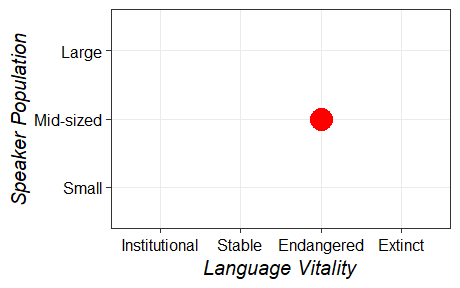 Click to enlarge with explanation
Place in Language Cloud
 Click to enlarge with explanation