
AIE ISO 639-3
Amara
A language of Papua New Guinea
- ISO 639
- aie
- Alternate Names
- Bibling, Longa
- Population
- 230 (2011 SIL), decreasing. No monolinguals.
- Location:
- West New Britain province: northwest coast, Anepmate, Kaugo, Niuniuai, Siamatai, and Waramasalai villages.
- Language Status
- 6b (Threatened).
- Classification
- Austronesian, Malayo-Polynesian, Central-Eastern Malayo-Polynesian, Eastern Malayo-Polynesian, Oceanic, Western Oceanic, North New Guinea, Ngero-Vitiaz, Vitiaz, Southwest New Britain, Amara
- Dialects
- None known. Related to Mouk-Aria [mwh] and Lamogai [lmg].
- Language Use
- One village shifting to Bariai [bch] and another village shifting to Maleu-Kilenge [mgl]. Vigorous use in only one village (Paris et al 2012a). In one village, all domains except church and prayer. In a second village, mixed use in all domains with Tok Pisin [tpi] and Bariai [bch]. In a third village, only used when interacting with residents of the other two villages (Paris et al 2012a). Some of all ages. Mixed attitudes, from positive to neutral. Most also use Bariai [bch] (Paris et al 2012a). Many also use Maleu-Kilenge [mgl] (Paris et al 2012a). Some also use Tok Pisin [tpi] (Paris et al 2012a). Used as L2 by Anem [anz], Maleu-Kilenge [mgl].
- Language Development
- Grammar.
- Language Resources
- OLAC resources in and about Amara
- Writing
- Latin script [Latn], used since 1980s.
- Other Comments
- Christian.
Also Spoken in
Map
Location: West New Britain province: northwest coast, Anepmate, Kaugo, Niuniuai, Siamatai, and Waramasalai villages.
Size and Vitality
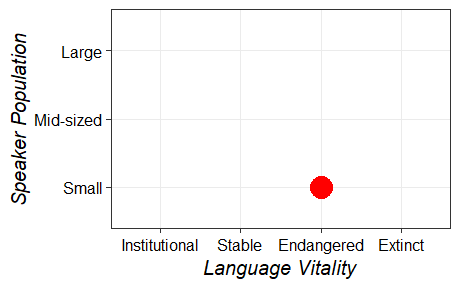 Click to enlarge with explanation
Place in Language Cloud
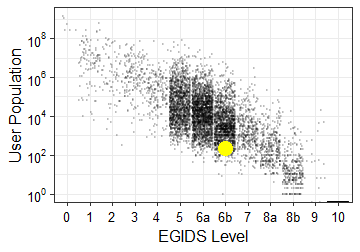 Click to enlarge with explanation