
AAT ISO 639-3
Albanian, Arvanitika
αρbε̰ρίσ̈τ (Arbërisht) Autonym
A language of Greece
- ISO 639
- aat
- Alternate Names
- Arberichte, Arbërisht, Arvanitic, Arvanitika
- Autonym
- αρbε̰ρίσ̈τ (Arbërisht)
- Population
- 50,000 (Salminen 2007). Ethnic population: 150,000.
- Location:
- Attica region: Athens; Central Greece region: Voiotia, south Evvoia and Salamis islands; Peloponnese region: Argolis and Korinthia areas, Messinia, from Kalamitra northwest, Lakonia, east coastal area near Rikhea; Southern Aegean: Kyklades, Andros island north; Western Greece: northwest Achaia, north of Lapas. Mainly rural, 300 villages.
- Language Status
- 8a (Moribund).
- Classification
- Indo-European, Albanian, Tosk
- Dialects
- Thracean Arvanitika, Northwestern Arvanitika, South Central Arvanitika. Partially intelligible with Albanian Tosk [als]. Dialects perceived as mutually unintelligible. A member of macrolanguage Albanian [sqi].
- Language Use
- Youth migrate to Athens and assimilate as Greeks. Some cultural revival since the 1980s. Rapid language shift so regular use is probably confined to a much smaller number of people (Salminen 2007). Older adults only. Shifted to Greek [ell].
- Language Development
- Dictionary. Grammar.
- Language Resources
- OLAC resources in and about Albanian, Arvanitika
- Writing
- Greek script [Grek].
- Other Comments
- The language is heavily influenced by Greek [ell]. Christian.
Also Spoken in
Map
Location: Attica region: Athens; Central Greece region: Voiotia, south Evvoia and Salamis islands; Peloponnese region: Argolis and Korinthia areas, Messinia, from Kalamitra northwest, Lakonia, east coastal area near Rikhea; Southern Aegean: Kyklades, Andros island north; Western Greece: northwest Achaia, north of Lapas. Mainly rural, 300 villages.
Size and Vitality
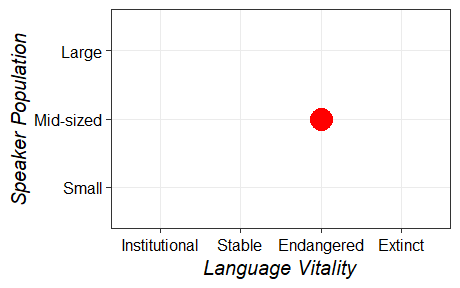 Click to enlarge with explanation
Place in Language Cloud
 Click to enlarge with explanation